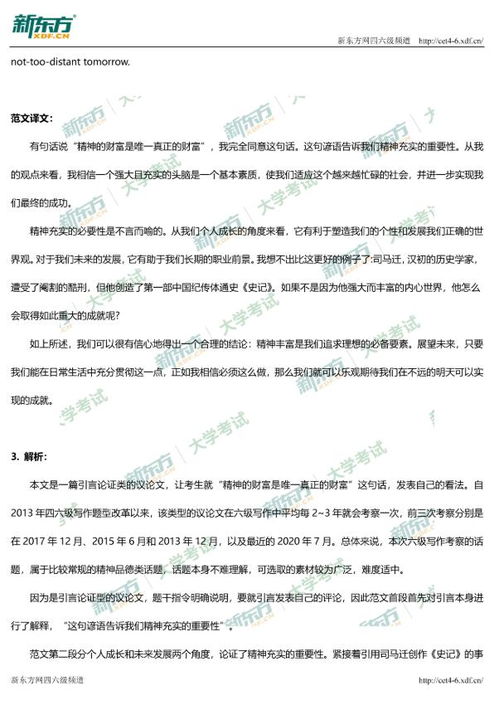
2020年9月大學(xué)英語(yǔ)六級(jí)考試的寫(xiě)作部分,題目為 The Wealth of the Mind(精神的財(cái)富)。這道題延續(xù)了六級(jí)作文常考的抽象哲理類話題,要求考生探討非物質(zhì)層面的“財(cái)富”,如知識(shí)、智慧、品格、心態(tài)等,并闡述其重要性。以下是對(duì)該真題的深度解析與一篇高分范文,供考生參考。
一、 真題解析與審題要點(diǎn)
- 題目類型:這是一道典型的“觀點(diǎn)論述型”作文。題目本身是一個(gè)名詞短語(yǔ),需要考生自行確立論述角度和中心論點(diǎn)。
- 核心概念:“Wealth of the Mind” 與物質(zhì)財(cái)富(material wealth)形成對(duì)比。它泛指一切內(nèi)在的、精神層面的豐盈與價(jià)值。
- 論述方向:考生可以從以下幾個(gè)角度切入(選擇一個(gè)或兩個(gè)展開(kāi)即可):
- 為什么精神的財(cái)富更重要?例如,它帶來(lái)持久的幸福、真正的自由、逆境中的韌性。
- 精神的財(cái)富包含什么?例如,知識(shí)、創(chuàng)造力、樂(lè)觀心態(tài)、道德感、審美能力等。
- 如何獲取精神的財(cái)富?例如,通過(guò)閱讀、學(xué)習(xí)、反思、藝術(shù)熏陶、與人深度交流等。
- 結(jié)構(gòu)建議:建議采用經(jīng)典的三段式結(jié)構(gòu)。
- 首段:引出話題,對(duì)比物質(zhì)財(cái)富與精神財(cái)富,明確提出自己的觀點(diǎn)(如:相比物質(zhì)財(cái)富,精神的財(cái)富更為根本和持久)。
- 主體段:用2-3個(gè)理由或例證支撐觀點(diǎn)。每個(gè)理由最好有具體的解釋和例證(可以是個(gè)人經(jīng)歷、名人故事或普遍現(xiàn)象)。
- 尾段:全文,強(qiáng)調(diào)精神財(cái)富的價(jià)值,并可提出建議(如我們應(yīng)該注重投資于自己的精神成長(zhǎng))。
二、 高分范文 (Sample Essay)
The Wealth of the Mind
In an era predominantly obsessed with material success and financial gain, the concept of “the wealth of the mind” serves as a crucial reminder of what truly enriches human life. While material possessions provide comfort and convenience, it is the intangible assets within us—knowledge, wisdom, and inner strength—that constitute the most valuable and enduring fortune.
Firstly, the wealth of the mind is the source of genuine happiness and resilience. Material wealth can be lost overnight due to market fluctuations or misfortunes, leading to anxiety and despair. In contrast, a well-cultivated mind, equipped with knowledge and a positive outlook, enables individuals to find joy in simple things and to withstand life's inevitable challenges. For instance, the renowned physicist Stephen Hawking, despite his severe physical limitations, possessed an immensely rich intellectual world, which allowed him to make groundbreaking contributions and lead a profoundly meaningful life. His story powerfully illustrates that a strong mind can triumph over physical adversity.
Moreover, mental wealth fosters creativity and personal growth, which are key drivers of social progress. A mind hungry for learning and open to new ideas is never stagnant. It constantly explores, innovates, and solves problems. Consider the great inventors, artists, and thinkers throughout history; their monumental achievements stemmed not from material abundance but from the richness of their intellect and imagination. This intellectual capital not only propels personal development but also collectively pushes the boundaries of human civilization.
In conclusion, while we may rightly pursue material well-being, we must never neglect the cultivation of our inner world. The wealth of the mind, encompassing wisdom, character, and intellectual curiosity, is the bedrock of a fulfilling and significant existence. Therefore, it is imperative that we invest time in reading, reflection, and the arts, thereby accumulating this priceless treasure that no one can take away.
三、 范文亮點(diǎn)與學(xué)習(xí)要點(diǎn)
- 觀點(diǎn)明確:開(kāi)篇直接對(duì)比物質(zhì)與精神財(cái)富,亮明立場(chǎng)——精神財(cái)富更持久、更有價(jià)值。
- 結(jié)構(gòu)清晰:采用“總-分-總”結(jié)構(gòu)。主體段用“Firstly”和 “Moreover” 引導(dǎo)兩個(gè)核心論點(diǎn):①帶來(lái)幸福與韌性;②激發(fā)創(chuàng)造力與成長(zhǎng)。每個(gè)論點(diǎn)后都有解釋和具體例證(霍金的例子、發(fā)明家藝術(shù)家群體)。
- 語(yǔ)言豐富:
- 詞匯運(yùn)用得體:
intangible assets(無(wú)形資產(chǎn)),enduring fortune(持久的財(cái)富),well-cultivated mind(修養(yǎng)良好的心智),withstand challenges(承受挑戰(zhàn)),intellectual capital(智力資本)。
- 句式多樣:使用了讓步狀語(yǔ)從句(While...)、定語(yǔ)從句、舉例結(jié)構(gòu)(For instance...)等。
- 例證恰當(dāng):霍金的例子非常貼切,有力證明了精神力量可以超越物質(zhì)困境。第二個(gè)例證從個(gè)體上升到群體,論證更有廣度。
- 結(jié)尾有力:觀點(diǎn)后,提出了具體的建議(invest time in reading, reflection, and the arts),使文章具有現(xiàn)實(shí)指導(dǎo)意義。
通過(guò)這道題的練習(xí),考生應(yīng)掌握對(duì)抽象話題進(jìn)行具體化、邏輯化論述的能力,并學(xué)會(huì)運(yùn)用恰當(dāng)例證支撐論點(diǎn),這正是六級(jí)寫(xiě)作考查的核心所在。